
Why Ramadan Weight Gain Happens — And How to Stop It
The Ramadan Weight Gain Nobody Talks About
Every year, the same story. Ramadan starts and Ramadan weight gain is the last thing on your mind. You think — okay, one meal less, surely I'll lose some weight. Then Eid arrives, and your kameez no longer fits. You're confused. You're frustrated. And your Aunt is somehow making it worse by saying, "Don't worry, everyone gets fat in Ramadan."
She's wrong, by the way. Ramadan weight gain is not inevitable. It's the result of specific eating patterns that almost everyone in Pakistani households falls into — and once you see them clearly, they're actually pretty easy to fix.
Why Your Body Gains Weight During Roza
Here's the thing: it's not about how many hours you fast. It's about what happens in the few hours you're eating.
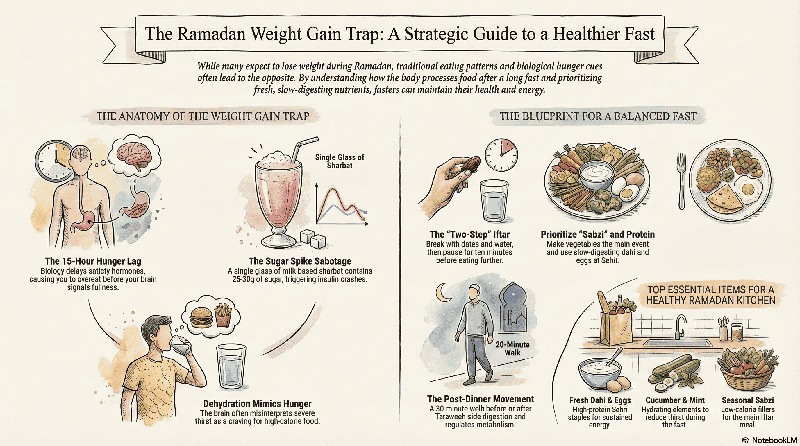
When you break your fast after 15+ hours, your body is in a state of genuine hunger — not "I missed lunch" hunger, real deep hunger. In that state, your appetite regulation goes sideways. The hormones that normally tell your brain "okay, enough" take longer to kick in. So by the time your brain catches up, you've already had two samosas, a bowl of chaat, a glass of Rooh Afza, and you're halfway through the biryani.
That's not a weakness. That's biology.
The problem compounds because most iftar spreads in Pakistani homes are built around fried, sugary, and heavily processed foods. Pakoras, rolls, dahi bhalla, and then a full dinner two hours later. The caloric load in that 4-6 hour window regularly exceeds what a person would eat across an entire normal day. Your body — which spent 15 hours in conservation mode — stores the excess efficiently as fat.
The Rooh Afza Problem
Real talk: we have a serious sugar habit in Ramadan. Sharbat, custard, kheer, firni, fruit chaat, drowning in chaat masala and syrup. A single glass of Rooh Afza with milk has roughly 25-30 grams of sugar. Most people have two. That's before the actual food starts.
Your insulin spikes hard. Then crashes. Then you're hungry again at sehri even though you ate enough to feed a small family at iftar.
The Sehri Mistake That Ruins Your Whole Day
Half the people I know either skip sehri entirely ("mujhe neend zyada pyaari hai") or eat leftover biryani at 3:45 AM. Both approaches destroy your energy and set you up for a brutal iftar binge.
Sehri should be slow-digesting. Dahi, eggs, and paratha made with proper atta (not maida), some fruit, a glass of water — this keeps your blood sugar stable across the fast. Refined carbs at sehri mean you crash by 11 AM and spend the rest of the day dreaming about pakoras.
The single best sehri upgrade? Fresh dahi with some fruit and a proper whole wheat roti. Simple, filling, and it actually lasts.
Finding fresh, quality dahi and produce for sehri at reasonable hours is honestly one of the underrated struggles of Ramadan in Islamabad. Nobody wants to drive to F-10 Markaz at midnight for tomatoes. This is exactly why FreshBox exists — same-day grocery and fresh produce delivery across Islamabad and Rawalpindi, covering F-6 all the way to Bahria Town and DHA. Over 19,000 orders delivered and counting, which tells you this isn't a new thing — people have figured out the convenience.
What a Ramadan Eating Pattern That Actually Works Looks Like
Iftar: Break the Fast Gently
Khajoor and paani first — this is Sunnah and also medically sound. Dates give you a quick glucose hit that prevents you from inhaling everything on the table in the first five minutes.
Then pause. Actually pause. Have some light soup or just sit for 10 minutes before going for the full spread. Your stomach has been empty for hours — flooding it with fried food immediately causes bloating, indigestion, and overeating.
For the actual iftar meal, load up on sabzi first. Not as a side — as the main event. Tinda, tori, karela if you can handle it, spinach with eggs. These fill you up with fewer calories and keep your digestion running smoothly through the night.
Dinner: Keep It Light, Not Heavy
The dinner after Taraweeh doesn't need to be a second iftar. A bowl of daal, some salad, a roti or two. That's it. The problem is most Pakistani households cook elaborate dinners during Ramadan — biryani, qorma, nihari — because guests come and guests expect effort. Understandable. But if you're eating that spread every night, the weight gain makes complete sense.
Sehri: Protein and Slow Carbs Only
Eggs in any form. Dahi. Oats if you're okay with them. Atta ki roti, not naan. A banana. Fresh mint chutney with cucumber and yogurt is honestly one of the best sehri combinations — filling, cooling, and it helps with thirst during the fast.
Cucumber kheeray is one of the most ordered items on FreshBox during Ramadan season for exactly this reason — people have figured out that hydrating vegetables at sehri make the fast significantly easier. Same with fresh dhaniya and podina — the demand for these spikes every Ramadan because fresh herbs make simple sehri food actually taste like something.
The Hydration Factor
You have about 8 hours between iftar and sehri to get your water intake in. Most people drink two glasses and call it a day. Then they wonder why they get headaches during the fast and why their appetite is out of control at iftar.
Dehydration mimics hunger. Your brain reads thirst as appetite. So part of why you're overeating at iftar is that you're actually just severely dehydrated from the day before.
Aim for 8-10 glasses of water between iftar and sehri. Not juice. Not sharbat. Water. I know it sounds boring. Do it anyway.
Movement During Ramadan
Nobody wants to hear "exercise more" during Ramadan. Fair. But completely cutting movement makes everything worse — digestion slows, sleep quality drops, and your metabolism adjusts downward.
The best time to move is after iftar dinner, before Taraweeh — a 20-minute walk does the job. Or after Taraweeh if you're someone who stays up later. Even a light walk around your colony after eating helps with digestion and keeps your body from storing everything you just consumed.
The Grocery Shopping Problem Nobody Talks About
Ramadan sabzi shopping is genuinely exhausting. Itwar Bazaar is chaotic on a good day — during Ramadan, with everyone trying to stock up for iftar, it's a completely different level. Lines are long, fresh produce moves fast, and if you're trying to eat healthily, you need things like fresh leafy vegetables and quality dairy that sell out quickly.
Ordering online for Ramadan grocery needs has started making real sense for Islamabad families. With over 4,800 customers and more than 512 orders delivered in just the last 30 days, fresh produce delivery has clearly become a normal part of how urban families here manage their kitchen. The top ordered items — tomatoes, onions, potatoes, fresh dahi, coriander, bananas — are exactly the sehri and iftar staples that you need reliably every day.
Having your pyaaz, tamatar, and dahi show up fresh at your door means you can focus on cooking something healthy instead of spending energy on the shopping itself.
So, Can You Actually Lose Weight in Ramadan?
Yes — and Ramadan weight gain is completely preventable. But it requires being intentional about those 4-6 hours you're eating. The fast itself isn't the weight loss mechanism — what you eat when you break it determines everything.
Fewer fried things at iftar. More vegetables. Proper hydration overnight. A real sehri. These four things, if you actually do them, will get you through Ramadan feeling better than when you started — not carrying an extra kilo or two that takes months to shift.
The sabzi is the most important part. Fresh vegetables, quality dairy, properly sourced produce — these are the foundation of a Ramadan eating pattern that supports your health rather than working against it. Everything else is details.
Good luck this Ramadan. May your atta be fresh, your dahi be thick, and your iftar spread contain at least one thing that isn't fried.
This article is for general information only and is not a substitute for professional medical advice. Always consult a qualified healthcare provider about your individual health needs.
Ready to start eating healthy?
Browse our selection of fresh produce and groceries, delivered to your doorstep in minutes.
Start Shopping
Written by
Faisal ShehzadFaisal Shehzad writes practical, locally-grounded guides on groceries, seasonal produce, nutrition and home cooking for households across Islamabad and Rawalpindi.
View all articles →