
How to Preserve Family Recipes: Save Your Dadi's Food Wisdom
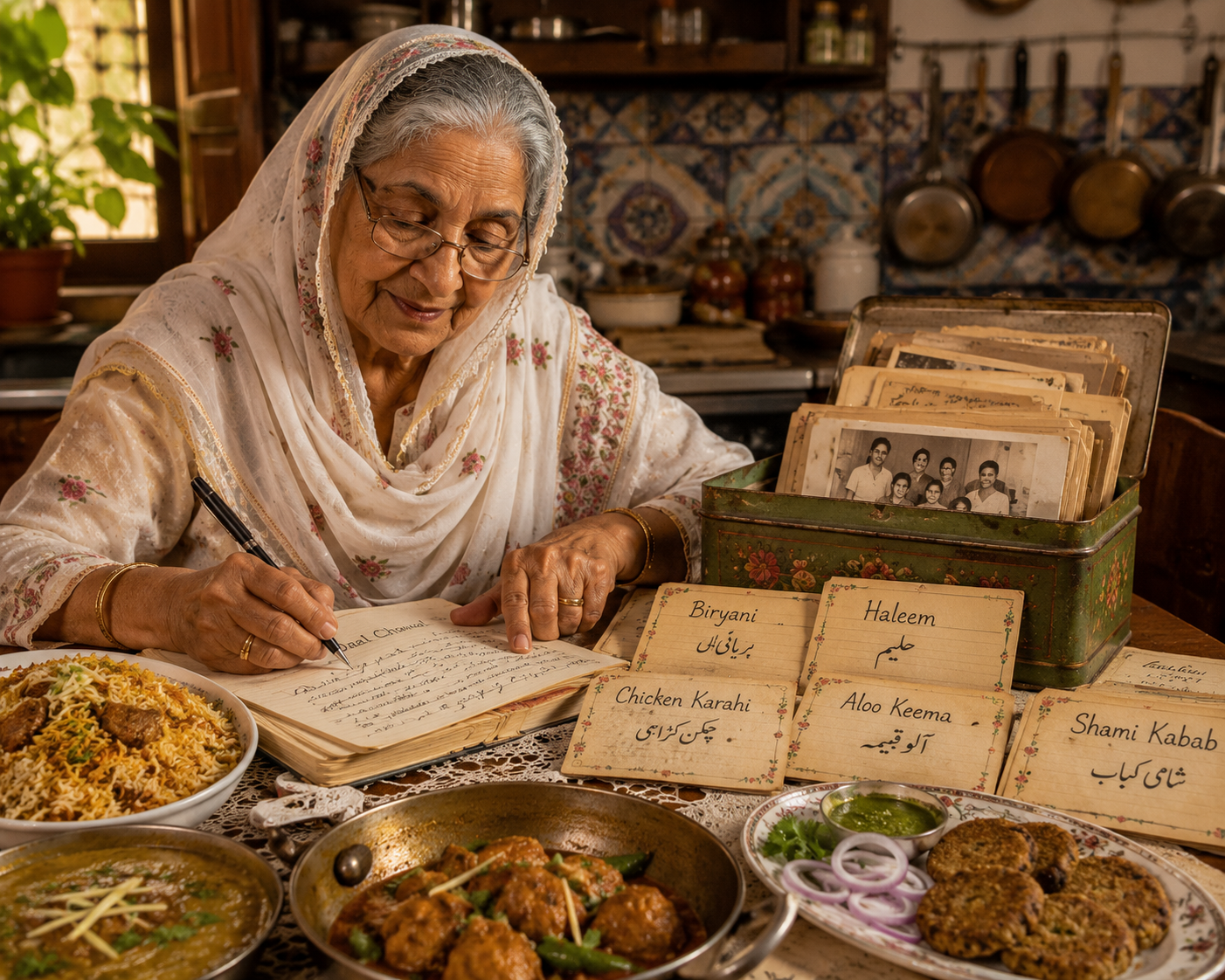
Your dadi's biryani. The secret yogurt marinade she never actually measured. How she knew her roti dough was perfectly kneaded just by the feel of it. That specific way she tempered the spices for curry—the exact moment she'd add the dried chilis before the seeds.
These aren't just recipes. They're evidence of a lifetime of cooking.
Every time a generation passes without documenting their methods, we lose not just instructions but an entire way of understanding food—the why behind each step, the wisdom about which ingredients matter and which don't, the shortcuts that only make sense if you've made the dish a hundred times. And they're vanishing.
Here's the thing: preserve family recipes isn't something we think about until it's too late. We assume our mothers and grandmothers will always be here to show us. Then suddenly, we're standing in the kitchen holding a phone, frantically texting our aunt asking "Wait, how much salt?" and realizing nobody actually wrote any of this down.
Why Generational Recipes Matter More Than You Think
Look, food memory is cultural memory. When you cook your dadi's aloo keema the exact way she taught you, you're not just making dinner. You're maintaining a connection to where your family comes from—whether that's a specific region of Punjab, Khyber Pakhtunkhwa, Sindh, or somewhere else entirely.
Every household in Islamabad and Rawalpindi has their own spice ratio for biryani. Their own way of layering rice. Their own trick for keeping the meat tender. These aren't minor variations. They're family signatures.
Food knowledge was traditionally passed down through observation and repetition. You watched your mom make samosas maybe a hundred times before you made them yourself. You stood next to your dadi while she sifted flour for chapati. You learned by doing, not by reading a recipe card.
But modern life doesn't work that way. Families are scattered between cities. Kids grow up without spending afternoons in the kitchen with their grandmothers. By the time they want to learn, the knowledge is harder to access.
Real talk: if you wait for the "perfect moment" to document your family recipes, that moment might never come. It's worth doing it now, imperfectly, rather than never doing it at all.
The Easiest Ways to Actually Preserve Family Recipes
Writing things down feels obvious, but most people still don't do it completely. You might jot down that a curry needs turmeric and ginger, but you miss the crucial detail that the ginger should be grated, not minced, and that it goes in during a specific stage of cooking.
A notebook works. A Google Doc works better—it's searchable and backed up. But honestly, video is the most valuable format. Just phone videos of your dadi or mom cooking, talking through what they're doing, explaining why. You'll catch details you missed the first time when you rewatch it.
Start small. Pick one recipe this week. Ask your mother or grandmother to make it while you film. Sit next to her and ask questions. Why are you stirring clockwise instead of counterclockwise? Does it matter? Half the time it doesn't. But sometimes it does, and you'll only discover that by asking.
Another approach: cook alongside them and take detailed notes. Write down ingredient amounts in weight, not cups—they're inconsistent. Note the type of pan, heat level, cooking times. Write down what the food looks and smells like at each stage. This detail separates a real recreation from an imposter version.
Your notes don't need professional formatting. They just need to be clear enough that you—or your kids, or your siblings—can follow them years from now.
Making Old Recipes Work in Modern Life
Here's the tricky part. Sometimes you preserve family recipes perfectly, but then you try to make it and it's... fine. Not bad, but not like you remember. This happens because you're using different ingredients than your dadi did.
The flour you buy at a supermarket in F-10 is different from what she ground herself. The yogurt isn't the same. The water has different mineral content. Even the gas flame on a modern stove behaves differently from a wood or coal fire.
This doesn't mean the recipe is broken. It means you adapt it slightly to modern ingredients and equipment. Try it once exactly as written. Then adjust based on what happened. More salt? Less time on heat? Different oil? Document these adjustments.
Your version of your dadi's recipe should be a tribute to hers, not a carbon copy. It should reflect the ingredients available to you now, in 2026, in Islamabad. That's how recipes actually evolve across generations.
Making It a Habit, Not a One-Off Project
The biggest reason people don't preserve family recipes is that they treat it as a single project with a deadline, not an ongoing practice.
Stop that. Treat it like a hobby. When you're cooking this week—whether that's making lassi or slow-cooked meat curry—take five minutes to jot down notes or film a video. Do it the same way you might photograph a meal you're proud of.
The more you normalize this, the more your family helps. Your mom will explain her methods without you asking. Your siblings will know to film when your dadi visits. Over a few months, you'll have a catalog of knowledge that would have been completely lost.
Share what you document. WhatsApp it to your cousins. Post it in a family group. Let it become part of your family's communication, not a mysterious archive. This creates accountability and spreads the knowledge.
The Ingredients Matter Too
When you're recreating a recipe, you're only halfway there with subpar ingredients. A curry is only as good as the spices you use. Fresh herbs make a difference. The quality of your ghee changes everything about how a biryani tastes.
You can order high-quality spices and produce from FreshBox, which handles sourcing so you can focus on perfecting your family recipes. Regardless of where you get ingredients, make sure they're the good kind—what your dadi probably bought from the vegetable market, not what's been sitting in a warehouse for months.
Start Today
Your family's food knowledge is waiting. It's living in your dadi's hands, your mom's muscle memory, your aunt's intuition about how much salt. And it's fragile. A single generation can watch it disappear completely.
Don't wait for the perfect time. Just start. Ask your grandmother to teach you her one special recipe. Film it. Write it down. Cook it again until you've got it right.
That's how you preserve family recipes. That's how you keep something alive that matters.
Frequently Asked Questions
What is the best way to preserve family recipes?
Why do family recipes taste different when I recreate them?
How do I start documenting my grandmother’s recipes?
What details should I write down for a family recipe?
Ready to start eating healthy?
Browse our selection of fresh produce and groceries, delivered to your doorstep in minutes.
Start Shopping
Written by
Faisal ShehzadFaisal Shehzad writes practical, locally-grounded guides on groceries, seasonal produce, nutrition and home cooking for households across Islamabad and Rawalpindi.
View all articles →